

Most guidance on choosing smart lockers is written for a single building. Choosing a system for tens of thousands of employees, or for multiple sites and countries, is a completely different exercise. This guide covers those differences.
What actually changes at scale?
Three things behave differently with a high headcount, or once you move beyond one site.
Exceptions stop being exceptions. One person forgetting their access card is a non-event, but across thousands of employees it becomes a significant daily support workload. This logic extends to locker reassignments, cleaning access and many other factors that are individually small but significant once multiplied across a large estate.
Inconsistency becomes expensive and time-consuming. If lockers behave differently in New York than in London, you are effectively running two systems: two sets of instructions for employees to learn, two support processes and two sets of internal communications every time something changes.
Procurement gets harder and more rigorous. A portfolio smart locker rollout for a large organisation involves information security, data privacy and detailed criteria that few vendors can pass.
Standardising the experience across every site
The target is simple to state: someone who works in Sydney on Monday and Singapore on Thursday should not have to learn anything new to open their locker.
In practice, that means one credential that works everywhere, one interface and one mental model. Organisations run into difficulty when they use different platforms or access methods in each region.
Standardising is not the same as making every site identical. Sites legitimately differ. An end-of-trip facility running day-use lockers in London has different rules from an executive floor in New York with permanently assigned storage. What should be consistent is how the system works. What can vary is the policy at each site.
How Yellowbox does this: Staff open their locker with the building access card they already carry at every site, with the Yellowbox app, Microsoft Teams, Outlook or a PIN available as alternatives. The same interface runs everywhere, so a new site inherits the experience rather than introducing a new one. Each site can still use its own locker types, rules and release schedules to suit how people work there.
Central visibility with local control
At scale, the hardest question to answer is: what is actually happening across the estate?
You need a single view across every site, including utilisation, idle lockers, lockers held long-term by people who no longer need them and hardware that needs attention, with the ability to drill into any building. When that data sits in separate systems for each site, nobody assembles the whole picture. Decisions about locker use and capacity are then made on instinct rather than evidence.
Local control is still critical. Site facilities teams need to resolve day-to-day issues without raising a ticket with head office, so software access must provide tiered administration for local actions while keeping global policies centrally controlled.
How Yellowbox does this: Every site runs from one dashboard, with live locker status and utilisation across the portfolio and the ability to drill into any location. Administrators can open any locker, reassign a booking or reclaim a locker being held long-term remotely, without a site visit. Site-level administrators handle day-to-day actions in their own building, while global policies stay centrally controlled. Local teams resolve issues without raising a ticket, and head office keeps one set of rules.
Locker allocation at scale
At a large scale, manual locker allocation is the first thing to break. At 50 lockers, a coordinator can manage assignments from a spreadsheet. At several thousand lockers across multiple sites, that becomes a permanent job. The bigger cost is the facilities time it consumes: hours every week spent on administration that produces nothing for the business.
There are two separate problems here, and they have different fixes.
Replace allocation with self-service booking
The answer is not a faster way to assign lockers. It is to stop assigning them. When employees book their own locker, the administrative work disappears and people get a better result than a coordinator could give them. They choose a locker that suits them by size, height and location, rather than being handed whatever was next on the list.
Automate onboarding and offboarding
This is a different problem, solved by connecting lockers to the system that already knows who works for you. Single sign-on means people use the account they already have. Automated provisioning means a new starter has locker access on day one, and a leaver loses it the moment HR records them as leaving, without anyone in facilities being told.
How Yellowbox does this: Employees book their own locker, so facilities teams are not fielding requests or maintaining a list. Single sign-on runs through Microsoft Entra, Okta or Google Workspace, and SCIM provisioning handles joiners, leavers and movers automatically. When someone leaves, their access ends immediately and the locker is flagged as abandoned, so the facilities team can check whether belongings are still inside before it returns to the pool. When the building access control system is integrated, the card that opens the front door opens the locker, so onboarding a new starter is one process rather than two.
Enterprise IT integrations
At one site, integrations are a convenience. Across a portfolio, they decide whether the system runs itself or becomes somebody’s job.
Four connections do most of the work at scale, and each is worth asking about.
- Identity management. Single sign-on and automated provisioning, so access is granted and removed by the system that already knows who works for you.
- Access control. The card that opens the front door should open the locker. Across a global estate, that rarely means a single access control vendor, so what matters is whether the platform works with the systems and card technologies already in place at each site.
- Workplace management. Where an organisation already runs a workplace management platform, lockers should appear alongside desks and rooms rather than sitting in a separate tool that people have to remember exists.
- Communication tools. If someone can book and open a locker inside an app they already have, adoption does not depend on persuading thousands of employees to install a new one.
A published integration count is useful. It shows a platform has been built to connect outward rather than sit on its own. What the number alone will not tell you is whether these four areas are covered for your particular technology stack. The follow-up question is what matters in procurement: are our identity provider, access control system and workplace platform on that list, and is each connection running live somewhere today?
How Yellowbox does this: Yellowbox runs hundreds of active API integrations. Single sign-on connects to the identity platform you already use, including Microsoft Entra, Okta and Google Workspace. Lockers open with the access card staff already carry, through integrations with access control platforms including Gallagher Command Centre, and can be booked inside workplace systems such as Serraview Engage, or in Microsoft Teams and Outlook. The Yellowbox app, a wallet pass, a PIN and the on-site touchscreen are all available as alternatives.
IT and information security considerations
This is the section that often decides multi-site deals, and it is where many locker vendors are least prepared.
Once a system spans a portfolio, questions from information security teams get sharper. What personal data does the platform hold? Where is it stored? Which jurisdictions does it cross? Can it be kept inside your own infrastructure?
There are three questions worth asking any vendor here, because not every platform can answer them.
1. Does the system have to hold personal data at all?
A locker system does not strictly need to know who you are. It needs to know that a valid credential is associated with a locker. For organisations with particularly strict privacy standards, Yellowbox offers Incognito Mode, which holds no personally identifiable information such as names or email addresses.
2. Where does the data live?
Deployment is either in the cloud or on-premise. Where policy or regulation requires data to stay in your own infrastructure, a Yellowbox on-premise deployment keeps it there.
3. How strong are the vendor’s information-security foundations?
Look for ISO 27001 certification, SOC 2 compliance, encryption in transit and at rest, organisation-scoped tenant isolation, a full audit trail, instant credential revocation and annual third-party penetration testing. Yellowbox provides all of these controls.
Phasing the rollout
For a portfolio rollout, we recommend a three-stage approach.
- Pilot at a representative site. The purpose is to settle what you cannot answer on paper: how people actually behave, what the support load looks like and what the communications need to say.
- Standardise before scaling. Fix the configuration, locker policy, welcome communications and support process based on what the pilot taught you. This is the step organisations skip, and skipping it produces fourteen slightly different deployments.
- Scale in waves, grouped by similarity rather than geography. Sites with the same locker type and working pattern can share a playbook.
Global rollout and support
A global rollout is not several national rollouts happening at the same time. The difference is who is on the ground.
Installation, commissioning and hardware faults are physical work and cannot be done from another time zone. Procurement review, data-protection sign-off and language requirements are local too. A vendor running a global estate entirely from its home market tends to be quick there and slow everywhere else, which is where multi-country programmes stall.
How Yellowbox does this: Yellowbox runs in more than 300 workplaces across 20 countries, with hundreds of active API integrations, more than 10 million locker opens a year and better than 99.5% uptime. Teams are based in Australia, the United Kingdom, the United States, Singapore, Malaysia and India, with live deployments across each of those regions rather than a single home market. Rollouts are coordinated centrally and delivered in region, so every site is installed and supported by people in its own time zone.
Operational efficiency and provable ROI
At scale, floor space is the expensive part, and lockers are usually provisioned on headcount rather than need.
Across our client sites, around 66% of employees use a locker and about 54% need one consistently. That gap is where the opportunity sits. When lockers are shared and released automatically rather than permanently assigned, one locker can serve multiple people, reducing the material spend and floor space required.
At one site, those savings can be marginal. Across a large or multi-site estate, they compound, and because the platform reports actual usage they are measurable rather than theoretical.
That last point is what makes the return provable. Most locker investments are signed off on an estimate because, once the lockers are installed, nobody can see how they are really being used. When the software measures actual usage and reports the space and administration savings for each site, you have hard data to put in front of finance and keep tracking as headcount and working patterns change.
How Yellowbox does this: Global booking limits stop individuals holding more capacity than they need. Camper tracking and automations identify lockers being held long-term and release them without a facilities team chasing anyone. Hot and temporary lockers let one locker serve several people across a week. Live utilisation metrics across every site show which buildings are over-provisioned and which are short, so capacity decisions are made on evidence rather than instinct and the ROI can be reported rather than assumed. If you need help sizing your estate, our locker quantity calculator gives a site-by-site estimate.
See how Yellowbox helped large and multi-site clients
- London Stock Exchange Group: LSEG put out a tender for a smart locker provider to support its current and future workplaces across multiple regions. Removing manual, labour-intensive locker processes was a primary objective.
- Canon: Yellowbox retrofitted an existing electronic locking system for the Fortune 500 company, replacing a server-based setup that had been in place for half a decade.
Planning your workplace locker strategy?
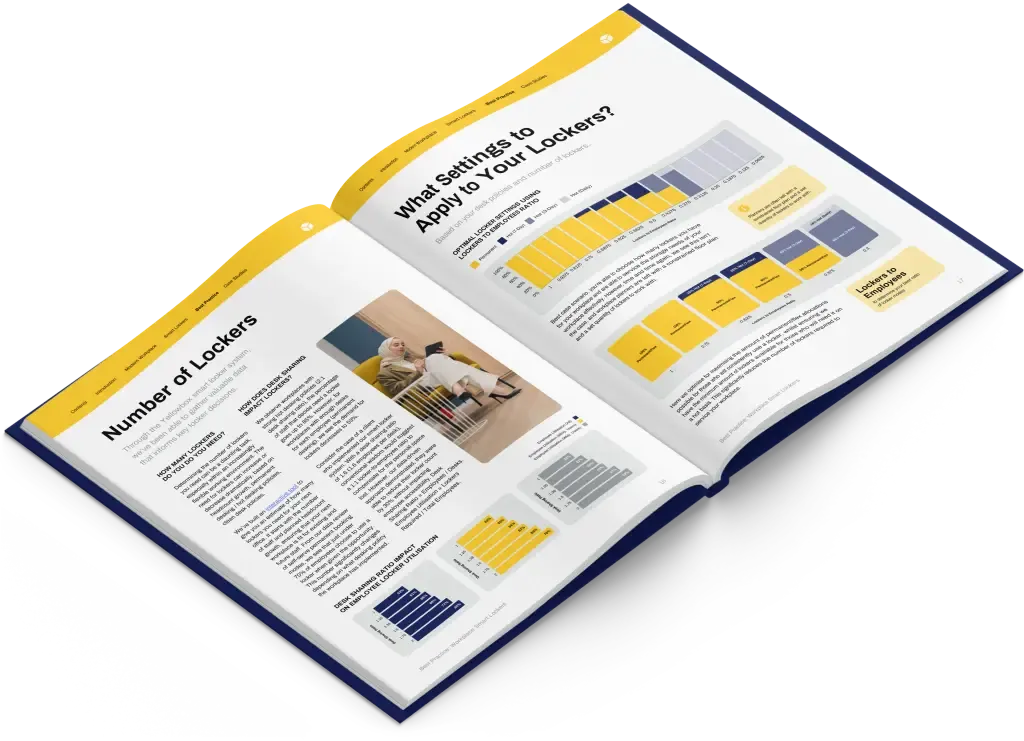
Get the best-practice guide to planning, implementing and managing workplace lockers, with insights from hundreds of workplaces.